
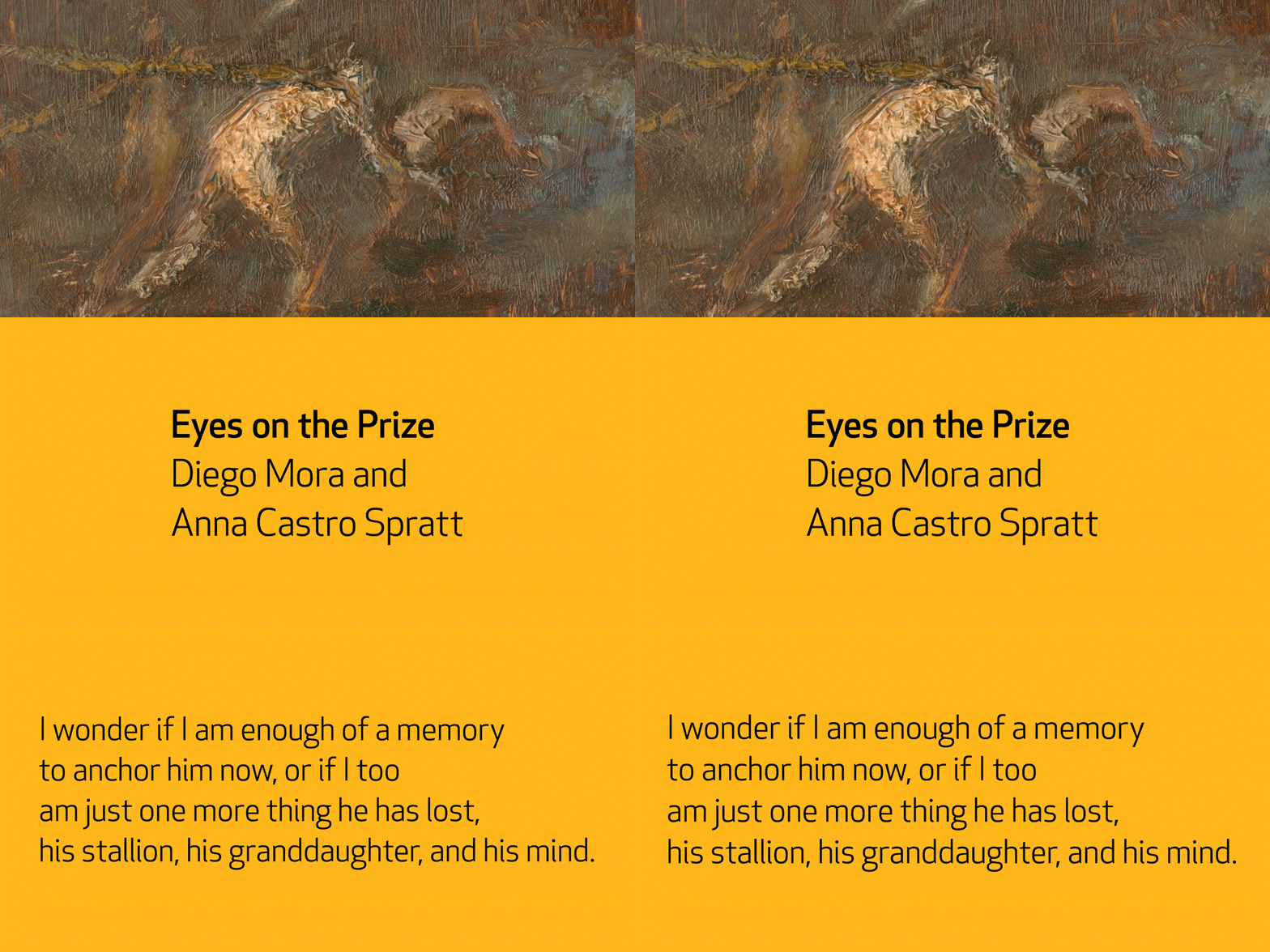
A Gold Medal Portfolio Award is the highest honor students can receive in the Scholastic Art & Writing Awards. Jurors choose portfolios by high school seniors whose works best represent the Scholastic Awards’ judging criteria: originality, skill, and the emergence of a personal vision or voice. These remarkable artists and writers will each receive a $12,500 scholarship.
Diego Mora
Derek Fordjour Art Portfolio Award
New York, NY
Be it to represent something I saw that left an impression on me, to express my vision about the world, or a message through metaphors or allegories, I am deeply interested in humanity. Specifically, I am interested in how we react to different situations and how a grander human experience relates to each individual person on the planet. “Trapping” humanity on any surface, no matter if it’s a traditional portrait or not. The empathy, you have to feel it. I enjoy the feeling of paintings connecting to the audience and the artist in a way that’s not just regarding beauty. I enjoy the telling of a story that connects to universal experiences that most people have or can relate to. It doesn’t have to be a complex situation, because even small events in life can be universal and relatable. There is a certain responsibility to this that has to be considered, if you’re trying to speak of the grander human experience, you must consider what it’s made out of, and make sure that it reflects life. I feel artists that do this type of work are connected to history no matter what, and are part of a larger group that goes back in time. Paintings that leave a strong impression don’t look like photos. They have to breathe. I am on a search for humanity, no matter if it’s a traditional portrait or a narrative-driven work. I deliberately choose to use oil paints most of the time because it allows me to switch between thick and thin areas of paint, to build form, add luminosity, and chase life-like illusions. I don’t necessarily work toward a photo-like effect; I work toward making my paintings feel like life. I want my paintings to breathe. For the watercolor painting in my portfolio, Quiero Cambio, I chose watercolor because the qualities of the medium such as water being almost uncontrollable and having its own will, would make the atmosphere of the painting naturally chaotic.
Toward the Light
Anna Castro Spratt
GV Group Writing Portfolio Award
Greenville, SC
This collection of poems reflects my experience as a Brazilian immigrant navigating the intersection of cultural expectations, personal identity, and the shifting terrain between two worlds. As I transitioned from Brazil to the United States at the age of eight, I found myself balancing both the expectations placed on me as a woman and the complexities of bridging two cultural narratives. Through poetry, I explore themes of beauty standards, female compliance, and Brazilian folktales that grew alongside me—Saçi Pererê, Emília, and Cuca—who served as symbols of resistance and resilience. The works in this portfolio delve into the pressure of embodying culturally specific beauty standards, especially as they were shaped by both Brazilian and American contexts. These standards often placed me in positions of compliance, where my identity and worth were defined by how closely I could align myself with ideals of beauty and behavior, expectations that varied between my native and adopted cultures. I also reflect on the subtle health nuances tied to my upbringing—experiences like encountering the chigoe flea, a uniquely Brazilian challenge, which underscores the bodily experiences that immigrants carry with them and how they shape our perceptions of health and belonging. Additionally, the folktales of Brazil, including characters like Saçi Pererê, Emília, and Cuca, represent more than childhood stories. They were integral to my development, shaping my understanding of resistance and identity. These figures, with their complexity and humor over Sunday morning cartoons, offered a sense of comfort and guidance as I navigated the intricacies of being a Brazilian girl in a new land. Each character was a piece of my journey, from the mischievous Saçi who refused to conform, to Emília and Cuca, whose own transformations and rivalries mirrored the forces of change I was facing.
The poems in this collection were carefully selected to communicate not only the emotional intricacies of immigration but also the deeper cultural forces at play. Through language and imagery, I aim to illustrate the sometimes painful, sometimes empowering journey of reconciling the narratives of my Brazilian roots with the demands of life in the States. Some poems lean heavily on the use of both Portuguese and English, reflecting the fluidity of communication and how words carry different weights in each language. The poetic form allowed me to explore fragmented emotions and fragmented identity—how the immigrant experience often feels like trying to stitch together stanzas that may never completely fit. Messages on cultural expectations, gender, health, and myth are woven throughout to reflect the broader immigrant experience and the personal evolution I continue to undergo. My goal is for the reader to see how these personal experiences, though deeply rooted in my Brazilian heritage, resonate universally in the lives of immigrants and anyone who navigates the complexities of belonging in more than one world. Ultimately, this collection is a way for me to give voice to my unique identity and to ask the question of how one can exist in between worlds without losing the essence of who they are.
Glass Granddaughter
He taught me how to ride a horse—
or maybe it was a pony, or maybe it was a stallion
as great as he was, trotting through the Brazilian
countryside and down the slope-hills he lived on,
his voice guiding me through miles of hips
up-down-up-down until we reached town
and tied the horses to a tree,
walked to Cristiano’s fake pharmacy,
a little store of mints and popsicles,
and bottles in brown bags I was just too young
to understand. I would be old enough, though,
two years later, when Cristiano is shot
in a robbery, and we stop galloping down.
We were used to this.
The American textbooks tell me, years later,
that I am from the ugly parts of Brazil.
But pieces of me recognize the distortion—
America has never seen the way the monkeys screech
when my grandfather chops at their tree,
or the way my grandmother screeched
when he fell from it.
It all happened quickly: the call from Minas Gerais
to South Carolina, my mother’s (for the first time) pale
face on the drive to Prince of Peace Catholic Church.
We sat for hours, hands up, praying,
a day before our flight, leaving candles
burning on the altar until they melted
the whole side of the building to the ground,
and I wondered if the stained glass shattered
the same way the doctors say my grandfather did.
He was in a coma for thirty-two days
before he woke, and then he never spoke again.
Instead, he stared pleasantly at me,
through me, glass-gazed giant,
smooth but impenetrable.
We shared the same memories,
but they hovered like bluebirds
on opposite sides of his Earth-breasted meadows—
His stallion, once fierce, barely bucked.
As growth geared me into woman,
I hoped to see him as he once was:
machete swinger, crop grower, farmer man
harvesting coffee beans like little brown candies
of the Earth, like soul ripped from callused dirt and weed.
White-people books called it dangerous
so I wrote the beauty in margins.
The pink of guava flesh, my grandmother’s arms
heavy with molding, soft pitted mangoes.
The children on bicycles racing the sun before dinner.
I wonder if he remembers the stallion
or the mints or Cristiano.
I wonder if I am enough of a memory
to anchor him now, or if I too
am just one more thing he has lost,
his stallion, his granddaughter, and his mind.
To see more Gold Medal Portfolio recipients, past and present, visit our Eyes on the Prize series.